
Euboea Island, Greece
Pilot Description
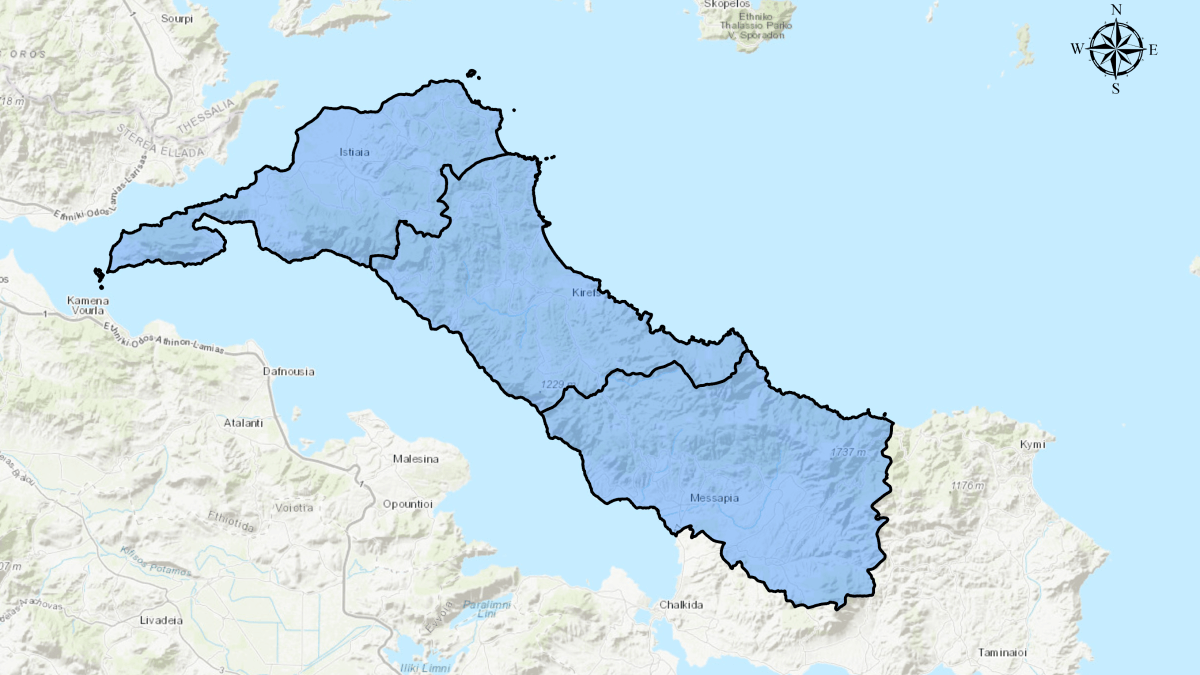
Euboea Island (Evia) is located in the eastern part of the geographical district of Sterea Ellada and is the second largest island in Greece with a total area of 4,167 km2. About 2,500 km2 of Evia is covered by forests, while the rest of the island consists of agricultural land, residential areas and barren rocky areas of high mountains. The area is dominated by pine forest and houses with a population of approximately of approximately 211,000 people. The population of North Euboea, the pilot area, is approximately 52,000 people. Approximately 24% of the population in North Euboea works in the agricultural sector, 10% in construction, 10% in tourism, 10% in catering services and 15% in services around the car industry. Also, mining activity is among the characteristics of local economy (magnesite in Mantoudi and Limni, iron and nickel in Dirfys). The cultural identity of the population in Euboea is similar to that of the people in the rest of Central Greece.
The most significant forest species that make up the forests of Euboea are Aleppo pine (Pinus halepensis), Firs (Abies sp.), Black pine (Pinus Nigra) and from the broadleaf, Chestnut (Castanea sativa), Oak (Quercus sp) and, sporadically, in small areas, other species, such as Platanus orientalis and Accer sp.
The climate of the area under consideration is of typical Mediterranean type and its bioclimatic type is medium-Mediterranean. The raining season occurs during the winter while in the summer months there is drought with high temperatures. Winters are mild and the average minimum temperature of the coldest month varies between 3°C to 7°C. The prevailing climate conditions, in the wider area, can be described as very favorable for the existing forest vegetation in the area with several rains falling mainly during most of the germination period.
The region is one of the most fire damaged in Greece. Frequent fires are the most serious risk of degradation of the forests. According to statistics from a period of nine years, 322 fires occurred annually in Evia, destroying about 1% of the total area of the regional unit that is about the triple of country’s average.
Phase A
Prevention & Preparedness
Phase B
Detection & Response Activities
Phase C
Restoration & Adaptation
Pilot Implementation
Organised by Consortium member Region of Central Greece, the Greek pilot was conducted in the vicinity of Gialtra in north Evia Island on October 30th, 2024. Team members from Region of Central Greece, Netcompany-Intrasoft, Hellenic Rescue Team, EXUS, Center for Security Studies (KEMEA), University of Thessaly, Agricultural University of Athens and Dell Technologies ensured efficient platform testing during the fire simulation exercise, with an emphasis on the following components:
- Fire Spread Model
- Health Impact Assessment (Air Quality Evaluation)
- Evacuation Route Planning
- Resource Allocation of Response Teams
- Forward Command Centre
- Silvanus Citizen Engagement and Fire Reporting App
- Platform Dashboard
Along with the SILVANUS team, the pilot implementation was made possible by the stakeholders from the Fire Service of the Industrial Area of Lamia, the police department, the emergency services, and the support of the local administration.
